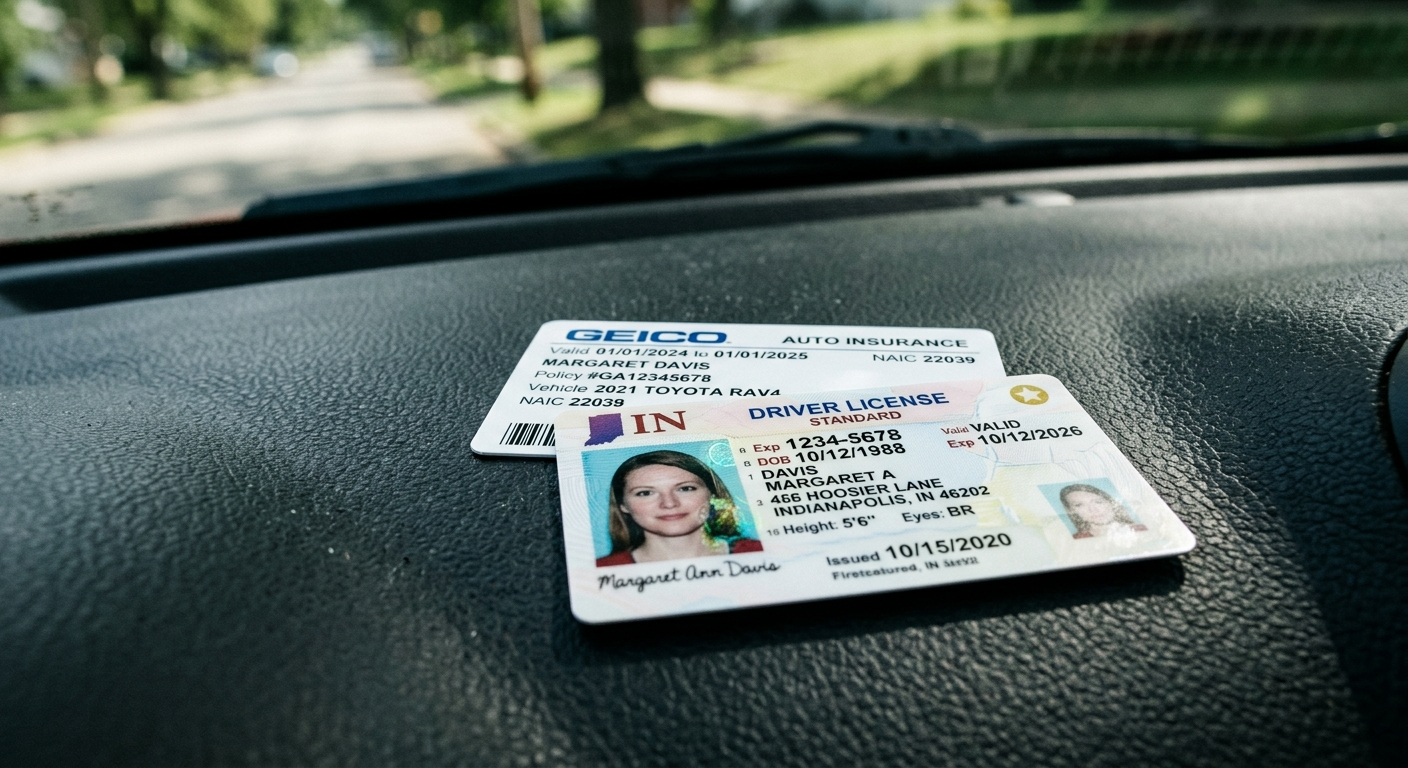
The Indiana Car Insurance Requirements You Actually Have to Meet
If you drive in Indiana, you have to carry liability insurance. That isn't optional, and it isn't waived because you have a clean record or only drive to church on Sundays. The state's Indiana car insurance requirements are set by statute, enforced by the BMV, and verified electronically every time your plates get pulled in a traffic stop or after an accident.
What trips people up is the gap between the legal minimum and what actually protects you when something goes wrong. A fender bender on US-50 outside Versailles costs more in 2026 than it did even three years ago, and the state minimums haven't kept pace. This guide walks through exactly what Indiana requires, what happens if you skip coverage, and how to think about limits that won't leave you exposed.
Indiana's 25/50/25 Minimum Liability Limits
Indiana Code 9-25-4-5 sets the minimum auto liability limits every driver must carry. The numbers are written as three figures separated by slashes, and they refer to the maximum amounts your policy will pay out per incident:
- $25,000 bodily injury per person — The most your insurer will pay for injuries to one other person you hurt in an at-fault crash.
- $50,000 bodily injury per accident — The total cap for all injured parties combined in a single crash.
- $25,000 property damage per accident — Covers damage you cause to other vehicles, fences, mailboxes, buildings, or anything else that isn't yours.
Indiana also requires uninsured/underinsured motorist (UM/UIM) coverage at the same 25/50 bodily injury limits unless you reject it in writing. Most agents will tell you to keep it. If a hit-and-run driver totals your car on State Road 129, that's the coverage that pays your medical bills.
What the Minimums Don't Include
Indiana does not require collision or comprehensive coverage. Those are the pieces that pay to fix or replace your own vehicle after a crash, a deer strike, hail, theft, or fire. If your car is financed or leased, your lender will require both. If you own the car outright and it's old enough that you wouldn't bother repairing it, you can legally drop them — but think hard before you do. A 2018 truck still has real cash value.
Medical payments (MedPay) and personal injury protection are also optional in Indiana. MedPay is inexpensive and pays your medical bills regardless of fault, which is useful since Indiana is an at-fault state and sorting out liability after a crash can take months.
Penalties for Driving Uninsured in Indiana
Indiana runs an electronic insurance verification system through the BMV. Carriers report active policies to the state, and the BMV cross-references vehicle registrations. If your insurance lapses — even for a week — the state knows.
The penalties scale with how many times you've been caught:
- First offense — 90-day driver's license suspension and a reinstatement fee of $150 to $250 once you can prove you're insured again.
- Second offense within three years — One-year suspension and a reinstatement fee up to $500.
- Third offense or beyond — One-year suspension and reinstatement fees up to $1,000.
- SR-22 filing requirement — After a suspension, the BMV typically requires an SR-22 financial responsibility filing from your insurer for three years, which signals to the state that you're maintaining coverage. SR-22s themselves are cheap to file, but they tag you as a high-risk driver and your premium goes up.
Get caught driving without insurance at the scene of an accident and the penalties stack. You'll also be personally liable for every dollar of damage and injury you caused — money the other driver's lawyer will pursue through wage garnishment and liens on your property.
Why Indiana's Minimums Often Aren't Enough
The $25,000 property damage minimum sounded reasonable when the law was last meaningfully updated. In 2026, the average new vehicle transaction price in the Midwest is over $46,000. A new pickup or SUV costs $55,000-$70,000 routinely. If you rear-end a fully loaded F-150 on I-74 and total it, the state minimum covers roughly a third of the replacement cost. The other two-thirds become a personal debt you owe.
Medical costs are worse. A single ambulance ride and ER visit in southeast Indiana runs $8,000-$15,000 before any surgery, imaging, or rehab. If you cause an accident that injures two people seriously, the $50,000 per-accident bodily injury cap can be exhausted before either person leaves the hospital. Whatever the policy doesn't cover, you owe.
Limits That Actually Protect You
Most independent agents in Indiana recommend liability limits well above the state floor. A reasonable starting point for most households:
- 100/300/100 — $100K per person, $300K per accident bodily injury, $100K property damage. This is the most common "middle-class default" and the limit at which most umbrella policies require you to sit before they'll write over you.
- 250/500/250 — Appropriate for higher net worth households, dual-income families, or anyone with meaningful home equity, retirement savings, or a business.
- Match your UM/UIM to your liability — If you carry 250/500 to protect others, carry the same to protect yourself when the at-fault driver has only state minimums (which, statistically, is common).
The price difference between state minimums and 100/300/100 is usually $15-$40 per month on a typical Indiana auto policy. That's not nothing, but it's a fraction of what one serious lawsuit would cost. For more on how rates are calculated and where premium dollars actually go, see our guide to lowering your Indiana auto insurance rates.
When Personal Umbrella Insurance Makes Sense
An umbrella policy is a layer of liability that sits on top of your auto and homeowners policies. Once those underlying limits are exhausted, the umbrella picks up — typically in $1 million increments. For roughly $200-$400 per year, you can add $1 million in extra liability protection across every vehicle, your home, and most personal liability claims.
Umbrellas are worth a serious look if you own a home, have teenage drivers, own rental property, have significant savings or investments, or just drive a lot of miles on rural Indiana highways where serious accidents tend to involve serious injuries. We cover the full case for this in our deep dive on personal umbrella insurance in Indiana.
If you'd rather not stack an umbrella, the alternative is simply carrying higher underlying limits — but you'll usually pay less and get broader protection by buying the umbrella than by trying to push your auto liability above 250/500.
Special Cases: Teen Drivers, Multiple Vehicles, and Older Cars
Adding a teenager to your policy is the single biggest premium event most Indiana families will face. Rates can double overnight, and the temptation to drop to state minimums to offset the cost is real. Resist it. A 16-year-old at fault in a serious crash creates the exact scenario that destroys families financially. Our teen driver insurance guide covers good-student discounts, driver's ed credits, and the right way to structure coverage for a household with a new driver.
If you have multiple vehicles, ask about a multi-car discount and confirm your liability limits stack appropriately. For an older paid-off vehicle, run the math on dropping collision and comp: if your annual premium for those coverages is more than 10% of the car's actual cash value, you're paying too much for what you'd ever get back in a claim.
Versailles, Osgood, Milan, Batesville — Talk to Someone Local
Indiana car insurance requirements are the same in every county, but rates aren't. Where you garage your vehicle, your driving record, your credit-based insurance score, the carriers competing in your zip code, and dozens of other factors push your premium up or down by hundreds of dollars per year. The cheapest policy that meets state minimums is almost never the right answer — but neither is the most expensive bundle a captive agent quotes you.
At Hardy Insurance Group , we've been an independent agency in Versailles since 1971. We shop your policy across 10+ carriers so you see what's actually competitive in southeast Indiana — not just what one company wants to sell you. If you're not sure whether you have the right coverage, or your renewal just landed and the number doesn't look right, request an auto quote or call us at (812) 689-5136 . We'll walk through your current limits, explain where you're exposed, and give you a real comparison. Visit our contact page to get started.