What home insurance covers (and what it doesn't)
If you own a home in Indiana, you've probably asked yourself at some point: home insurance, what does it cover exactly? The policy document is long, the jargon is thick, and most people don't find out what's missing until they're standing in front of a flooded basement or a tree through the roof. This post breaks down every major coverage component in plain language, explains what Indiana homeowners should pay close attention to, and flags the gaps that catch people off guard.
The six standard coverage parts of a homeowners policy
A standard homeowners insurance policy in Indiana is built on six coverage sections, each labeled with a letter. Understanding what each one does helps you know what you're actually paying for.
Coverage A: dwelling
Coverage A pays to repair or rebuild the physical structure of your home after a covered loss. That means the walls, roof, foundation, attached garage, and built-in systems like your HVAC and electrical panel. The number to watch here is your dwelling limit , which should reflect the cost to rebuild your home from the ground up, not its market value or what you paid for it. In Indiana, construction costs have climbed significantly in recent years, so it's worth reviewing this figure every year or two to make sure you're not sitting on a coverage gap.
Coverage B: other structures
Coverage B extends protection to structures on your property that aren't attached to your home: a detached garage, a fence, a storage shed, or a pergola. Most policies default to 10% of your dwelling limit for this coverage. If you've invested in a large outbuilding or workshop, that 10% may not be enough, and you can usually increase it.
Coverage C: personal property
Coverage C covers your belongings, including furniture, electronics, clothing, and appliances, if they're stolen or damaged by a covered event. There's an important distinction between actual cash value (ACV) and replacement cost value (RCV) . ACV pays what your five-year-old television is worth today (not much). RCV pays what it would cost to buy a comparable new one. RCV coverage costs a little more, but the payout difference after a claim is often substantial.
Also watch for sublimits on high-value items . Jewelry, firearms, collectibles, and musical instruments typically have their own per-item caps, often as low as $1,500 for jewelry. A scheduled personal property endorsement can cover these items at their full appraised value.
Coverage D: loss of use
Coverage D pays your additional living expenses if a covered loss makes your home temporarily uninhabitable. That includes hotel bills, restaurant meals beyond what you'd normally spend, and short-term rental costs. Most Indiana families would struggle to absorb even a few weeks of hotel stays out of pocket, so this coverage matters more than people realize until they need it.
Coverage E: personal liability
Coverage E protects you if someone is injured on your property and sues you, or if you accidentally cause property damage to someone else. A standard policy carries $100,000 to $300,000 in liability coverage. Because a single serious injury lawsuit can easily exceed those limits, many Indiana homeowners pair this with a personal umbrella policy for an additional layer of protection at a modest cost.
Coverage F: medical payments
Coverage F is a no-fault coverage that pays small medical bills for a guest injured on your property, regardless of fault. Limits are typically low, $1,000 to $5,000, and it's designed to handle minor incidents quickly without triggering a liability claim.
What perils are actually covered?
Indiana homeowners policies are almost always written on an open perils basis for the dwelling (Coverage A), meaning your home is covered for any cause of loss that is not specifically excluded. For personal property, many policies use a named perils form, meaning only the specific events listed in the policy are covered.
Common covered perils include:
- Fire and smoke: one of the most common and costliest claims in the state
- Wind and hail: a major concern in Indiana, especially during spring and summer storm seasons
- Lightning: including damage to electronics caused by a power surge from a direct strike
- Theft and vandalism: both on-premises and, under most policies, to property temporarily stored elsewhere
- Falling objects: such as tree limbs or ice dams collapsing onto the roof
- Weight of ice and snow: relevant in Indiana winters when heavy accumulation can damage roofs and overhangs
- Sudden and accidental discharge of water: from a burst pipe, for example
Indiana sits in a region with real tornado and severe wind exposure. If you want to understand how wind and hail claims are handled in detail, including deductible structures specific to those events, take a look at how tornado and wind damage works under Indiana homeowners policies.
What homeowners insurance does NOT cover
This is where the surprises happen. Several significant risks are excluded from standard homeowners policies, and Indiana homeowners need to plan for them separately.
Flooding
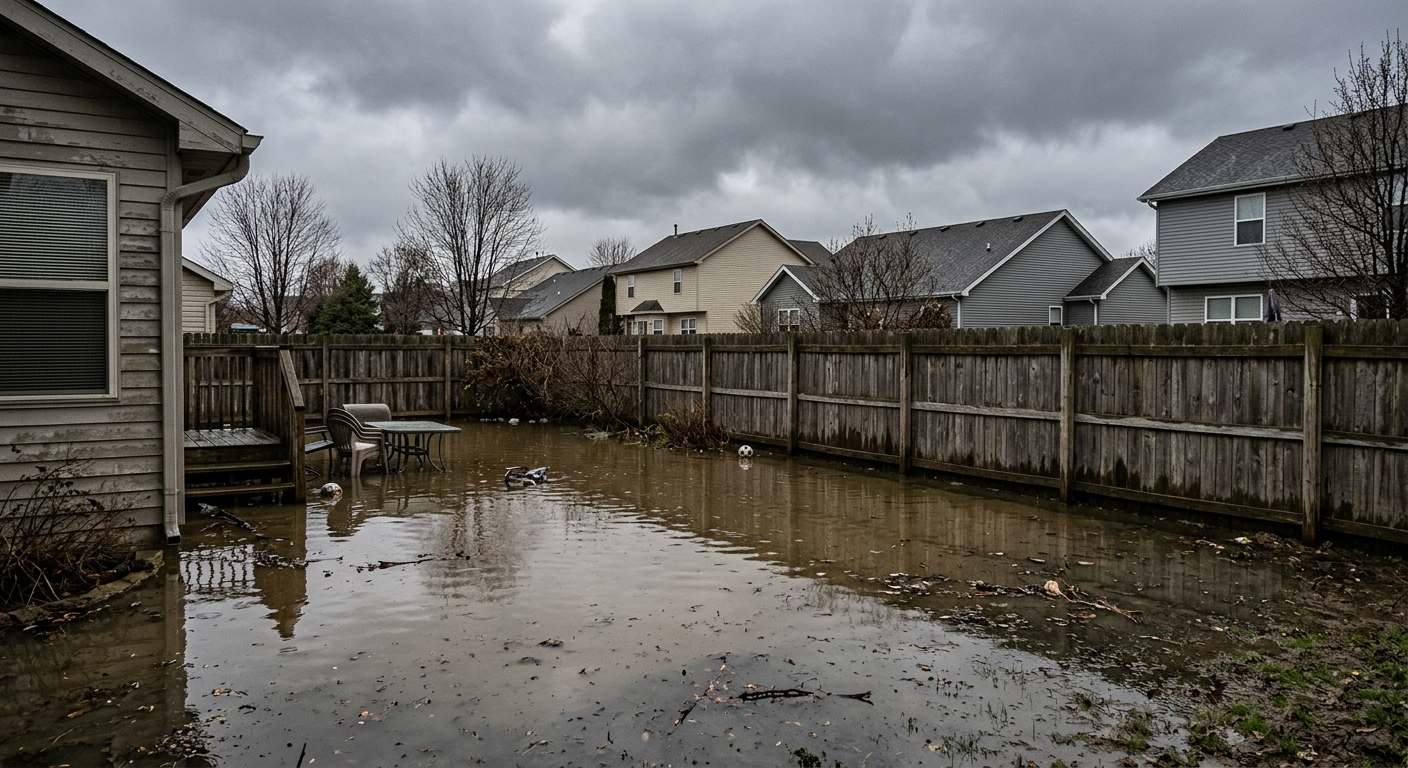
Flood damage is not covered by a standard homeowners policy. This is one of the most misunderstood facts in personal insurance. Flooding from heavy rain, rising rivers, or overland water requires a separate flood insurance policy, typically purchased through the National Flood Insurance Program (NFIP) or a private flood carrier. Indiana has seen significant flooding events along the Ohio River and its tributaries, and even properties outside official flood zones can experience water damage from unexpected storm events. We've covered this exclusion in depth in our post on whether homeowners insurance covers flooding in Indiana.
Sewer and drain backup
Water backing up through a sewer line or drain is also excluded from most base policies. This is a separate endorsement you can add, usually for a relatively modest annual premium, and it covers cleanup and damage from a sewage backup. It's a messy, expensive event that happens more often than homeowners expect.
Earthquake
Indiana is not a high-seismic state, but the New Madrid Seismic Zone does extend into southern Indiana. Earthquake damage is excluded from standard policies and requires a separate endorsement or policy. For most Indiana homeowners this is lower priority, but the exclusion is worth knowing about.
Gradual deterioration and neglect
Homeowners insurance is designed to cover sudden and accidental losses , not problems that develop slowly over time. A roof that leaks because it wasn't maintained, mold that grew over months, or a foundation that shifted gradually are not covered. Insurance adjusters look at the timeline of a loss, and gradual damage is a common reason for partial or full claim denial.
Home-based business equipment and liability
If you run a business from home, your standard homeowners policy likely provides very limited coverage for business equipment and almost no coverage for business liability. A home-based business endorsement or a separate commercial policy is the right solution, depending on the scale of your operation.
How dwelling coverage limits work in Indiana
One of the most common mistakes Indiana homeowners make is setting their dwelling limit too low. The correct number is your home's replacement cost , which is what it would take to rebuild the structure at today's labor and material prices. This is almost always different from the market value, the appraised value, and what you paid for the home.
After the inflation in construction costs over the past several years, many Indiana homeowners who haven't reviewed their policy recently may be significantly underinsured. If your home were destroyed by a fire tomorrow and your dwelling limit was been set three or four years ago, the payout might cover only a fraction of what rebuilding would actually cost.
Ask your agent to run a replacement cost estimator at renewal. It takes a few minutes and can prevent a serious financial shortfall after a major loss. For more on keeping your coverage aligned with actual costs, our guide on lowering Indiana homeowners insurance premiums covers ways to stay properly covered without overpaying.
Special considerations for Indiana homeowners
Indiana's climate and geography create a few specific coverage situations worth mentioning directly.
Severe weather is a regular part of life here. Hail storms, straight-line winds, and tornadoes move through the state from spring through early fall, and winter brings ice storms and heavy snow loads. Wind and hail is one of the most frequent claim types filed by Indiana homeowners, and some policies now include a separate wind/hail deductible, calculated as a percentage of the dwelling value rather than a flat dollar amount. Read your declarations page carefully to understand which deductible applies to weather-related losses.
Older homes in communities throughout southern Indiana, including the Versailles area, sometimes carry ordinance or law exclusions that could leave you short if a partial loss triggers a requirement to bring the full structure up to current building codes. An ordinance or law endorsement covers that gap.
First-time homebuyers often don't realize how much flexibility exists in structuring a policy. If you're buying your first home, the article on insurance for first-time homebuyers in Indiana is a good place to start before your closing date.
Get the right coverage for your Indiana home
Understanding what your homeowners policy actually covers is the first step toward making sure you have the right protection. The second step is working with someone who can compare options across multiple carriers to find the policy that fits your specific home, location, and budget.
Hardy Insurance Group is an independent insurance agency serving Indiana homeowners. As an independent agency, we work with multiple insurance companies, which means we compare rates and coverage options on your behalf rather than being limited to a single carrier's offerings. That matters when you're trying to get the right dwelling limit, add the right endorsements, and avoid paying for coverage you don't need.
Give us a call at (812) 689-5136 or reach out through our contact page to get a homeowners insurance review or a fresh quote. Whether you're buying a new home, renewing an existing policy, or just want to make sure your coverage has kept up with what your home is worth, we're glad to help.